
An insight here from news agency AP on the current state of Lebanese heath services, where hospitals are at breaking point and medical staff exhausted:
Drenched in sweat, doctors check patients lying on stretchers in the reception area of Lebanon’s largest public hospital. Air conditioners are turned off, except in operating rooms and storage units, to save on fuel.
Medics scramble to find alternatives to saline solutions after the hospital ran out. The shortages are overwhelming, the medical staff exhausted. And with a new surge in coronavirus cases, Lebanon’s hospitals are at a breaking point.
The country’s health sector is a casualty of the multiple crises that have plunged Lebanon into a downward spiral – a financial and economic meltdown, compounded by a complete failure of the government, runaway corruption and a pandemic that isn’t going away.
The collapse is all the more dramatic since only a few years ago, Lebanon was a leader in medical care in the Arab world. The region’s rich and famous came to this small Mideast nation of 6 million for everything, from major hospital procedures to plastic surgeries.
The Rafik Hariri University hospital is Lebanon’s largest public hospital and the country’s No 1 for the treatment of coronavirus patients. Lebanon has so far registered nearly 590,000 infections and over 8,000 deaths.
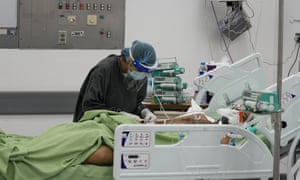
The hospital, which depended on the state power company, had to start relying on generators for at least 12 hours a day. Since last Monday, the generators have been the only source of power, running non-stop. Most of the hospital’s diesel, sold at the black market at five times the official price, is either donated by political parties or international aid groups.
To save on fuel, some rooms run only electrical fans in the sweltering summer heat. Not all hospital elevators are working. Bed capacity has been downsized by about 15% and the ER admits only life-threatening cases.
It is a perpetual crisis that has left the hospital always on the brink, says its director, Firas Abiad. There are “shortages of almost everything.”
Every day, he struggles to secure more fuel – the hospital has a maximum two-day supply at any time. Shelves are thin on medicines, including for cancer patients and dialysis. A new aid shipment of blood serum will last just a few days.
“We can hardly get by,” said Jihad Bikai, head of the ER. He recently had to send a critical patient to another hospital because he no longer has a vascular surgeon on staff.
On a recent afternoon at the Rafik Hariri hospital, nurse Mustafa Harqous, 39, tried to ignore the ruckus outside the coronavirus ER: patients with oxygen masks waiting for a bed to free up, families pressing to visit sick relatives, others arguing over out-of-stock drugs.
He went about his work in the 25-bed room. Except for a month-old baby, the patients were mostly men in their 30s and 40s.

“Some people understand the shortages are not our fault,” he said. “But many don’t.”
He worries how he will fill up his car for the drive home, an hour and a half away. The government, he said, is “leaving people in the middle of the sea with no rescue boat.”
Reports say at least 2,500 doctors and nurses have left Lebanon this year. At the Rafik Hariri hospital, at least 30% of doctors and more than 10% of nurses left, most recently five in one day. Many private hospitals, who offer 80% of Lebanon’s medical services, are shutting down because of lack of resources or turning away patients who can’t pay.
Bikai, the 37-year-old ER chief, was offered a job in a neighbouring country. His salary is barely enough to cover his son’s dentist’s bills. His wife, also a doctor, works by his side in the ER.
“There is a moment, when you are pushing hard to get over a mountain, and you get to a place, you can’t move,” he said. “I worry we’ll get to that.”
Abiad, the hospital director, struggles to remain positive for his staff.
“Our country is disintegrating in front of our eyes,” he said. “The most difficult part is … we can’t seem to be able to find a way to stop this deterioration.”
Australia must start to learn to live with Covid-19 when higher vaccination targets are reached, Prime Minister Scott Morrison said on Monday, despite concerns in some states about the impact of a surge in cases in Sydney.
With over half of all Australians stuck in weeks-long lockdowns to curb the highly infectious Delta strain, Morrison said the country had to move forward and start reducing restrictions as more people became vaccinated, Reuters reports.
He said during a televised media conference in Canberra:
(Lockdowns) cannot go on forever. This is not a sustainable way to live in this country.
This groundhog day has to end, and it will end when we start getting to 70% and 80% (vaccination rates).
Morrison spoke just as tighter restrictions took effect in Australia’s largest city, Sydney. As of Monday, masks are mandated outside the home, except when exercising, and a night time curfew is in place in the 12 worst-affected council areas.
The federal government last month unveiled a four-stage plan to relax restrictions once 70% of its 25 million people aged over 16 are vaccinated, with stringent lockdowns “unlikely” to be required.
When vaccination coverage reaches 80% only “highly targeted lockdowns” would be necessary and inoculated Australians would be free to travel interstate.
Differences have emerged between states that want to maintain a focus on suppressing the virus and the largest state of New South Wales, which is seeking a path out of lockdowns through vaccinations following a large Delta outbreak.
Western Australia and Queensland states, which are largely coronavirus-free, have flagged they may still maintain some restrictions even when vaccination targets are reached.
They say the national plan, which was agreed before the NSW outbreak, was based on having only small outbreaks present in the community.
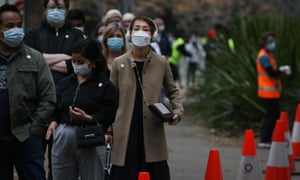
On Monday, NSW reported 818 cases, most of them in Sydney, slightly down from the record 830 a day earlier.
NSW Premier Gladys Berejiklian urged people to focus less on cases and more on the immunisation rollout.
“Once you get to 80% double dose, every state will have to live with Covid. You cannot keep Delta out forever,” she said.
In Victoria, home to Melbourne, 71 new cases were detected with 55 having spent time in the community while infectious, which state Premier Daniel Andrews said could derail plans to exit lockdown on 2 September.
While Australia has managed the pandemic better than many other developed countries, a slow vaccine rollout has taken the gloss off its early success.
Nationally, 30% of people above 16 are fully vaccinated, while 52% have had a least one dose. Vaccinations are running at a record pace but the target of 80% fully vaccinated will not be reached until December at the current rate.
Australia has reported just over 44,600 cases in total. There have been 984 deaths, although the death rate has declined since last year.
The arrival of the Delta strain in New Zealand has prompted the country’s Covid-19 response minister to question the efficacy of its ambitious elimination strategy – an approach that has been the backbone of the country’s pandemic response.
Chris Hipkins told current affairs programme Q+A on Sunday that Delta raised “big questions about the long-term future of our plans”.
“Delta does raise some big questions that we’re going to have to grapple with, you know less than a 24-hour period for someone getting it and passing it on to others … that’s like nothing we’ve dealt with in this pandemic so far, and it does change everything,” he said.
US civil rights leader Jesse Jackson and his wife are “responding positively” to treatments after catching Covid-19, their son said in a statement.
Physicians at the Northwestern University Memorial Hospital in Chicago are carefully monitoring Jackson, 79, and his wife, Jacqueline, 77, Reuters reports, a day after the two were hospitalised, their son Jonathan said in a statement issued by the Rainbow PUSH Coalition, a group founded by his father.
“Both are resting comfortably and are responding positively to their treatments,” he said.

Jackson, who was diagnosed with Parkinson’s disease in 2017, has been a leader of the U.S. civil rights movement since the mid-1960s and was with Martin Luther King when he was assassinated in 1968.
Jackson sought the Democratic presidential nomination twice in the 1980s, but fell short of becoming the first Black major party White House nominee.
He was awarded the Legion d’Honneur by French president Emmanuel Macron in July, one of France’s highest honours, in recognition of what he called “a long walk towards emancipation and justice”.
Weeks after the Delta variant of the coronavirus ripped through Jakarta, the Indonesian capital has reached “herd immunity”, the city’s deputy governor said, ahead of an expected decision by the president today on whether to extend Covid-19 curbs.
For much of last month, Jakarta was devastated by the outbreak with inundated hospitals, oxygen shortages and Covid-19 patients dying at home, but in recent weeks case numbers have dropped sharply, while vaccination rates have climbed.
On 12 July, Jakarta recorded more than 14,600 infections, but by Sunday the figure had fallen to 700, Reuters reports.
“Jakarta has entered the green zone and has reached herd immunity,” deputy Jakarta governor Ahmad Rizia Patria told reporters on Sunday.
The deputy governor was referring to high vaccination rates in the capital, where more than 54% of residents are fully vaccinated and most have received one shot.
Nationally, just over 11% of the population have been fully vaccinated since the south-east Asian nation began its inoculation programme this January.
Pandu Riono, an epidemiologist at the University of Indonesia, said the deputy governor had misunderstood the concept of herd immunity.
“Even if we reach 100% vaccine coverage, the immunity level is still below 80%,” he said, adding that vaccine efficacy levels were only about 55%.
Home to more than 10 million people, Jakarta has predominately administered China’s Sinovac vaccine, while some residents have received Astra Zeneca and Sinopharm shots.
President Joko Widodo is expected to announce on Monday whether current social restrictions that have been in place since July in Java and Bali will be relaxed or extended.
The government has in recent weeks maintained social curbs but permitted limited capacity at malls and restaurants.
Despite an overall decline in cases nationally, Indonesia still recorded more than 12,000 cases on Sunday, as it continues to battle one of Asia’s worst coronavirus outbreaks.
Since mid-July the country has also recorded more than than 1,000 deaths from Covid-19 each day, one of the highest rates globally.
While cases have declined in Jakarta and some parts of Java, the highly contagious Delta continues to surge in other islands, including in parts of Sumatra, Kalimantan, Sulawesi and remote Papua.
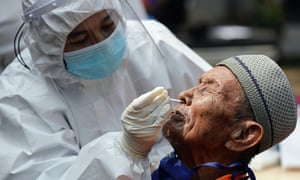
China’s health authority reported on Monday that there were no new locally transmitted Covid cases for the first time since July, offering more signs that the current outbreak that began late last month may be tapering off soon.
Reuters: The latest outbreak was driven mainly by infections first detected among a few airport workers in the eastern city of Nanjing on 20 July. Since then, more than 1,200 people in China have been confirmed to be infected.
The outbreak has spurred local authorities across the country to impose tough counter-epidemic measures including mass testing for millions of people to identify and isolate carriers, as well as treat the infected.
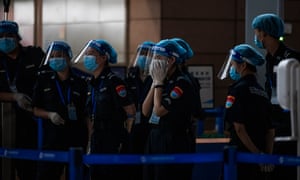
No one has died in the current outbreak, which has largely focused on the cities of Nanjing and Yangzhou in the province of Jiangsu, near the financial hub of Shanghai. Across China, new local cases fell to the single-digits last week, after peaking in early August.
But over the weekend, Shanghai placed hundreds of people under quarantine after infections were found in cargo workers at one of its two airports, sparking concerns of a fresh outbreak in the city.
Shanghai has reported no new local infections since then.
from WordPress https://ift.tt/3yaM0Yv
via IFTTT

No comments:
Post a Comment